

Housed in the 19th century lighthouse at Trinity Buoy Wharf in London, Longplayer began its run on January 1, 2000 with a monumental goal of playing uninterrupted and without repeating until December 31, 2999. Basically it’s an insane millennium-long musical loop. The piece was conceived of by musician, artist, and computer scientist Jem Finer. In 1995, while on tour with The Pogues, Finer was interested in creating different methods that could compose music in real time.
The origins of Longplayer were soon born using a sound loop 20 minutes, 20 seconds long. Using a precise, calculated formula, this loop was then laid out end-to-end along six timelines of differing lengths and scheduled to begin playing simultaneously at midnight on January 1, 2000. The start point of each of the short loops would then be updated every two minutes. That slight offset of time ensures the entire piece would not repeat for exactly 1,000 years.

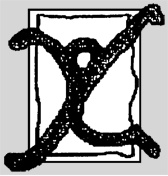
Jem Finer’s original Longplayer calculations
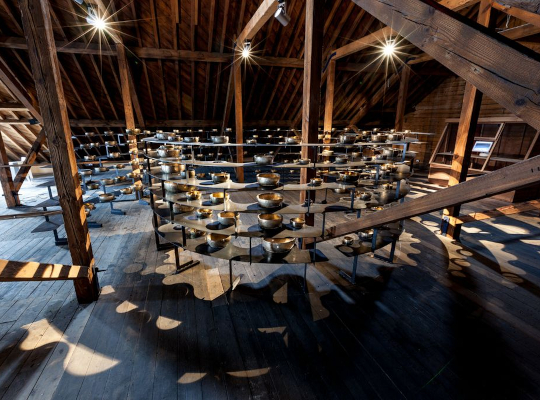
The genius behind this was that by using a mathematical construct, different parts of the piece can be performed live, in sync with the source material. This has already happened. For example, on 5th April 2025 from 7:20 am to midnight, a 1000-minute section of Longplayer was performed live at The Roundhouse in London by physically tapping 234 Tibetan standing bells and gongs of different sizes. It also means that the source material can itself change formats in order to keep up with inevitable hardware maintenance and software updates.
When the time came, the piece started out as a recording running on an Apple iMac. While that was suitable for starting Longplayer, Finer felt it would not hold up over time. He knew that it required technology more reliable and less complicated than that of a personal computer. Today, the source material uses the SuperCollider programming language running on Raspberry Pi which plays the recorded sound.
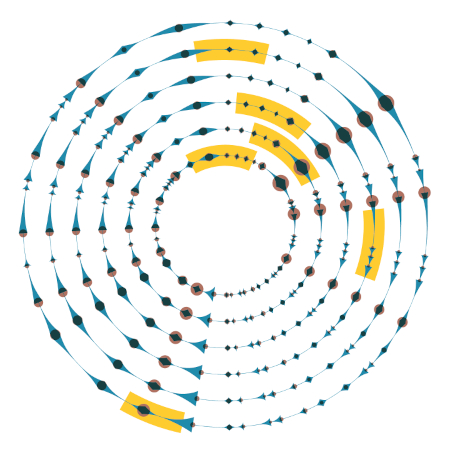
A graphic representation of the Longplayer composition
I must confess, I don’t really know what any of that means but it doesn’t matter. What fascinates me is the nature of the music itself. The algorithm that will guide it. The way it lives in this evolving, malleable style similar to shorter pieces by John Cage, Brian Eno, or Harry Partch but on a hugely exaggerated timeline. What’s more is it is almost impossible to envision the obstacles and changes that will show themselves over coming centuries.
Already running for nearly 26 years, the future of Longplayer is equally bright and unknown, exciting and terrifying. Check out the video below of a segment recorded in 2003.
Looks like I’m adding yet another pin to my travel map. Hopefully I’ll get to London soon so I can experience this piece in person.
Hello wealthy benefactors . . . I’m waiting.
Cheers!
Stephen
