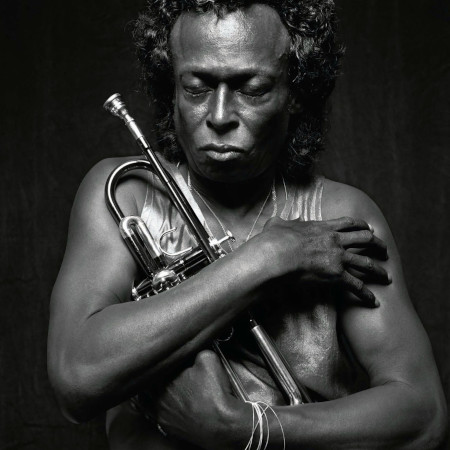
Born on May 26, 1926 Miles Davis was fearless. He redefined what it meant to be a jazz artist many times over. He never stood still for long. He changed styles unpredictably and unapologetically, much to the chigrin of so-called purists. At times there were feelings of resentment, betrayal, and even anger. I for one believe a true purist accepts that the need for mercurial changes is at the heart of jazz. Here’s a rough timeline of Davis’s career:
- 1945 thru 1948 – Bebop
- 1949 thru 1950 – Cool Jazz
- 1955 thru 1959 – Hard Bop
- 1959 thru 1963 – Modal Jazz
- 1964 thru 1968 – Post Bop
- 1969 thru 1975 – Electric Fusion
- 1981 thru 1991 – Pop Funk
As a young musician, I was inspired by what is his most controversial and polarizing period. Davis really pissed people off when he had the audacity to plug in the instruments and tinker with an avant-garde, experimental fusion of jazz and rock from 1969 – 1975. Oh the humanity! That time in his career was famously left out of the 2001 ‘Jazz’ PBS series by Ken Burns because musical director Wynton Marsalis didn’t consider it to be jazz. Again, the impudence of a purist. No disrespect to Marsalis’s talent.
I had my share of unconventional guitar teachers who introduced me to more uncommon music and playing techniques than the standard fare. One teacher had me run exercises out of a clarinet book to open me to new ways of thinking. Another told me to listen to the likes of King Crimson, Talking Heads, and of course Miles Davis. Particularly ‘Bitches Brew’ (1970). This was one of the most impactful experiences for me. I didn’t need to be a horn player to benefit from Davis’s wide reaching impact.
A band of unlikely collaborators, under the stern tutelage of Davis, created what would become the foundation of progressive jazz fusion. The long, fiery jams and loose arrangements opened my mind to a whole new galaxy of creative possibilities. Music and sound are interchangeable. Dissonance and harmony are one in the same. The notes you don’t play are more important than the ones you do. On that album — as well as ‘In A Silent Way’ (1969) — I discovered the mastery of guitarist John McLaughlin, who would also become a major influence on my playing.

So why did Davis’s electric years impact me so? More than the musical education from Davis himself, there was a plethora of great guitarists that would join his bands, each lending a uniqueness to the sound. It can’t be overstated how amazing it was for a legend like Miles Davis to welcome the creative input of fresh innovative players on his journey. Whether that be horns, keys, guitar, or whatever. He’d often yield the spotlight for them to shine, despite his well-earned reputation of being a hard ass.
Davis once said to John McLaughlin, “Play like you don’t know how to play the guitar.” Meaning he should let go of convention and take unexpected avenues of tone and harmonic exploration, which he’d go on to do with projects like Mahavishnu Orchestra and Shakti.
There was the daring alliance of Pete Cosey and Reggie Lucas. Bouncing ingenious craziness off of each other like a sonic tennis match.
The heavy rock and blues-infused edge of Mike Stern played a key role in Davis’s funk/pop comeback during the 1980s. During this time Davis also adopted the use of more synthesizers and hip-hop beats.
Side Note: I saw Miles Davis live in 1985 at Music on the Pier in NYC. Mike Stern was on guitar. The funk was so heavy that bassist Darryl Jones broke a string. The opening act was a then newcomer, guitarist Stanley Jordan. This was well into Davis’s comeback era. He had wear a rubber corset to provide the core support needed to play his trumpet due to several ailments going back to the late 70s. Despite all of that, the show was phenomenal.
Adding a singularly melodic, bebop feel to the sound was John Scofield, who would go on to create some of his own uniquely groundbreaking recordings. He too would be a huge influence on my playing.
Robben Ford had a short but impactful time with Davis, bringing a heavy blues-rock virtuosity to his later sound.

Some may disagree that Davis’s electric endeavours were his most influential because each of his many incarnations can be said to be such. However, to fully delve into each of these is not something I’m prepared or frankly even qualified to do. I can only speak to the impact his music has had on me. The sheer explosive nature of cascading and combusting sounds grabbed me. Not only was there the perceived absurdity of electric guitars and modern (at the time) synthesizers, Davis would overdrive his trumpet, run it thru delay and wah pedals, dreaming up a new, cosmic palette of sound.
To learn more, take a trip down the rabbit hole that is his catalog. No matter your taste, I guarantee you will find inspiration there in the constant ebb and flow that are the tides of Miles Davis.
Cheers!
Stephen
Website → milesdavis.com